If you truly love nature,
you will find beauty everywhere.Vincent Van Gogh

Practical Peace in daily living.

“2CELLOS Luka Sulic and Stjepan Hauser
playing their arrangement of Thunderstruck
by AC/DC Ba-Rock style!”

The prompt for the featured image of this post was:
“The image captures a theatrical performance scene with a striking visual contrast. Two cellists stand center stage in elaborate 18th-century Baroque/Rococo-style costumes — think powdered-era aristocracy, with ornate cream and lavender jackets, ruffled collars, breeches, and white stockings. Each holds a cello, positioned next to ornate gilded armchairs with upholstered cushions.
Flanking the stage are attendants or guards in matching period costume — red coats with light blue sashes — holding back heavy golden curtains, framing the scene like a royal court presentation.
In the foreground, you can see the backs of audience members’ heads, many sporting elaborate white powdered wigs and period hairstyles, completing the illusion that this is a classical concert from centuries past. The dim, dramatic lighting and the formal theater setting heighten the sense of refined elegance.”


“You can either be a host to God
or a hostage to your ego.
It’s your call.”
“What obscures truth is not ignorance of concepts, but subtle tension—mental, emotional, and bodily—that contracts awareness into the feeling of being a separate person.”
It’s a classic nondual pointer, and it’s a bit of a trap disguised as insight.
The idea is this: the “ego” is the sense of a separate self that believes it can improve, fix, or eliminate itself. So when the thought arises, “I need to get rid of my ego,” that very movement is still coming from the same structure—it’s just ego trying to become a better, more spiritual ego.
It’s like a wave trying to flatten itself back into the ocean. The effort reinforces the sense that there’s a separate entity in control.
What this points toward instead is not removal but recognition:
A simple example:
If irritation comes up and the mind says, “I shouldn’t feel this—I need to transcend this,” that’s ego refining itself. But if irritation is just noticed—felt, allowed, not owned as “me”—it tends to dissolve on its own without a manager.
So the phrase isn’t saying ego is bad—it’s pointing out that the project of eliminating ego keeps the illusion going.
If you’ve been sitting with nondual teachings, this is basically a nudge from “doing” toward “seeing.”
TBA
The following content has been generated by ai (notebooklm.google.com):

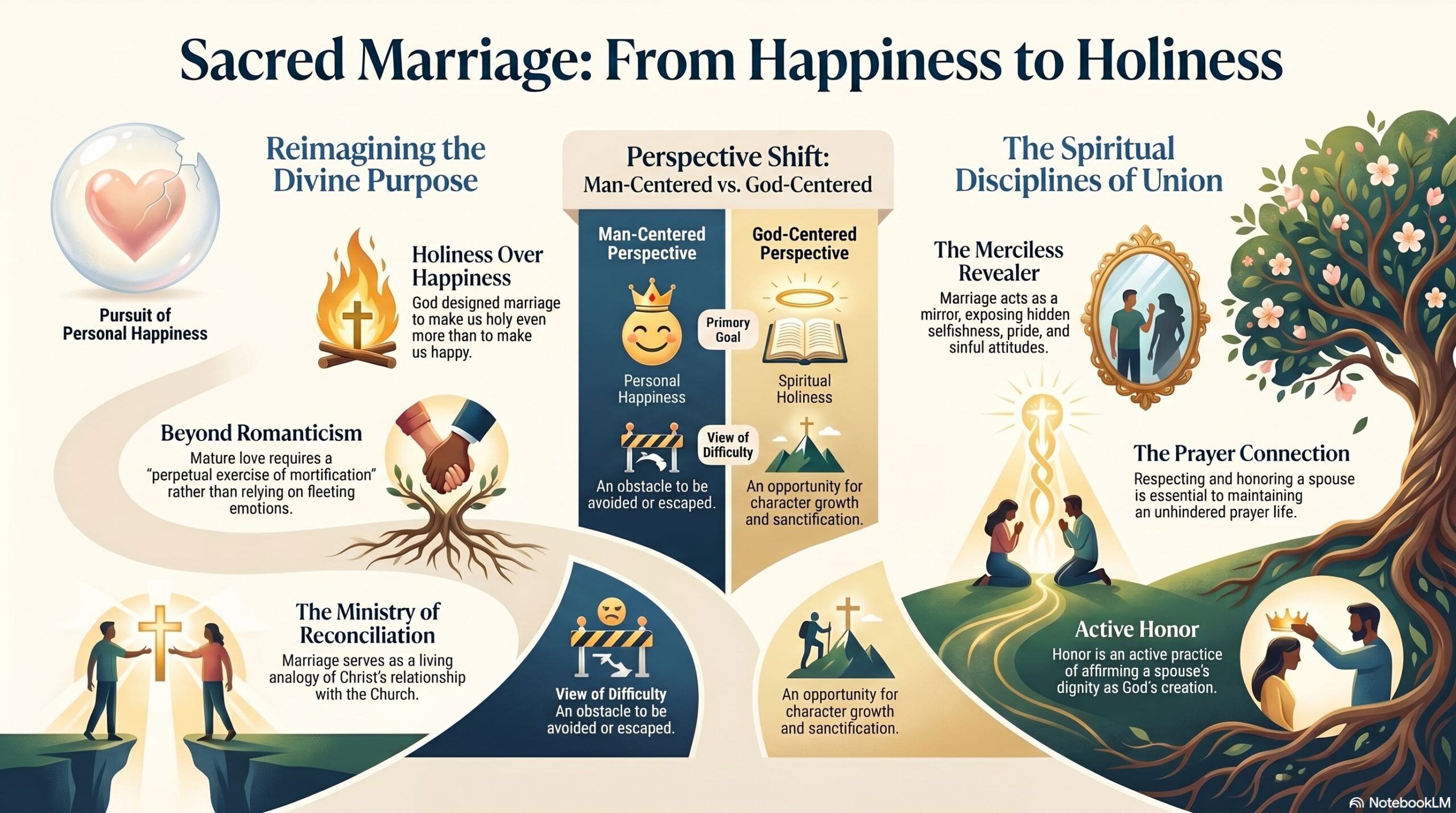
The provided text features excerpts from Gary Thomas’s book, Sacred Marriage, which proposes that the primary purpose of matrimony is to foster personal holiness rather than merely achieving individual happiness. Thomas argues that the challenges and routines of domestic life serve as a spiritual crucible, exposing human selfishness and refining Christian character through the practice of unwavering love and reconciliation. By moving away from modern romanticism, the author suggests that couples can view their partnership as a living analogy for the relationship between Christ and the church. The text includes various theological reflections and personal anecdotes to demonstrate how the struggles of marriage provide unique opportunities to encounter God and grow in virtue. Ultimately, the work encourages readers to prioritize divine pleasing over personal fulfillment, treating their spouse with a level of respect and service that mirrors God’s grace.


Beyond the Fairy Tale: 5 Surprising Ways Marriage is Designed to Shape Your Soul
The transition from the “romantic roller coaster” of courtship to the flat terrain of daily life often leads to a profound sense of disillusionment. We enter into unions fueled by infatuation, only to find the “happily ever after” replaced by the routine of paying bills, cleaning the house, and navigating the friction of two distinct personalities. When the initial spark fades, many couples conclude they have made a mistake. However, we must recognize that this shift does not signify failure; rather, it marks the beginning of marriage’s true, transformative purpose.
To find spiritual meaning in the domestic routine, we must look through a counter-intuitive lens. We often prioritize our own comfort, yet a deeper reality exists: marriage was never intended to be an end in itself. We must ask the defining question of our unions:
“What if God designed marriage to make us holy more than to make us happy?”
In the seventeenth century, spiritual director Francis de Sales noted that the state of marriage requires more virtue and constancy than any other, describing it as a “perpetual exercise of mortification.” For the modern reader, mortification simply means the “dying to oneself.” While contemporary culture views marriage as a personal adventure meant to provide happiness, a mature spiritual view recognizes it as a demanding ministry that forces us to confront our own ego.
We must view the challenges of marriage through the analogy of the thyme plant. Despite the “bitter nature” of the plant’s juice—representing the struggles, disappointments, and daily confrontations with our own selfishness—it is through this very bitterness that one draws the “honey of a holy life.” The struggle is not a detour from spiritual growth; it is the catalyst for it. When we shift from a romanticized view to a spiritually sensitive one, we stop trying to change our spouse to suit our comfort and begin allowing the relationship to refine our character.
Marriage acts as a “merciless revealer,” a searchlight turned on the darkest places of human nature. It removes the “anesthetic” of distance that we enjoy while single and forces us to confront our internal wretchedness and character flaws. Single people can hide their impatience or selfishness by simply going home; married people live with their “unveiled faces” under twenty-four-hour surveillance.
Consider the absurdity of the “Ice Cube Tray” revelation. I once found myself boiling with disproportionate irritation at finding empty ice cube trays in the freezer. I actually went so far as to time how long it took to fill the tray: exactly seven seconds. That realization was a stinging indictment of my own heart. Was I really so self-centered that I would let seven seconds of inconvenience become a marital grievance? This proximity ensures there is no hiding. As Helen Rowland famously noted:
“Marriage is the operation by which a woman’s vanity and a man’s egotism are extracted without anesthetic.”
By seeing our sin reflected in the eyes of our spouse, we are forced to choose between the safety of defensiveness and the growth of humility.
In many struggling marriages, partners become adversaries, using caustic communication to tear each other down. We see this in couples who have become so full of mutual contempt that they view each other with malicious glee. The remedy is a rigorous spiritual discipline: we must have “contempt for contempt.”
This requires an internal shift from judging a spouse’s failures to examining our own hearts. We must adopt a “Holy Double Standard,” which means being hard on ourselves and easy on our spouse—focusing on the “plank” in our own eye rather than the “speck” in theirs. To build a culture of honor, we should practice these four steps:
Biblical teaching, specifically 1 Corinthians 7:5, links marital intimacy directly to the health of one’s prayer life. We must understand that life is a “seamless garment”; we cannot separate our “holy” selves from our “husband” or “wife” selves. If a husband is inconsiderate or fails to respect his wife, his prayers are literally “hindered” (1 Peter 3:7).
Marital intimacy is not merely a physical release; it is an act of spiritual authenticity. When we meet our spouse’s needs—both emotional and sexual—we remove the distractions of frustration and place our souls at rest, creating a climate for contemplative prayer. We must realize that God is a part of the sexual encounter. By serving each other with passion and purity, we are not compromising our spirituality; we are expressing it. As I have learned in my own journey:
“If you want to be a stronger prayer, I’d have to be considerate of Lisa. I’d have to respect her, cherish her, and honor her.”
In a “throwaway society,” a lasting marriage serves as a vital ministry of reconciliation. The stakes are incredibly high: pollster George Barna has noted that “born-again” Christians actually have a higher divorce rate (27%) than non-believers (23%), with “fundamentalist” Christians reaching 30%. When we seek dissolution, we sabotage the very message of the Gospel we claim to believe.
Consider the 700-year-old trees on the western slope of the North Cascades. These trees aren’t famous for their beauty, but for the simple fact that they survived. They went the distance, enduring centuries of lightning strikes. A marriage that endures commands the world’s attention. By “sticking it out,” a couple creates a monument to the principle of reconciliation, pointing the world toward a Creator who seeks to reconcile with humanity. In this sense, endurance is a form of evangelism. Staying married makes people ask why, providing the platform to talk about a God who never gives up on us.
Marriage is a “crucible”—the spiritual gym of life where the character of Jesus is developed through resistance and repetition. While a spouse can never “be God” or fill the ultimate spiritual ache in the human soul, they are the ideal partner for the difficult work of sanctification. By embracing the challenges of the union, we learn to love the “different” and find fulfillment in our Creator rather than in our partner’s perfection.
The question remains: Are you willing to stop running from the struggle and let your spouse be the mirror that helps you become the person God created you to be?
Sacred Marriage: A Foundation for Spiritual Transformation
This briefing document synthesizes the core principles of Gary Thomas’s Sacred Marriage, focusing on the transformative potential of the marital union. The central thesis is that marriage was designed by God to make participants holy even more than to make them happy. By shifting the focus from romantic fulfillment to spiritual discipline, marriage becomes a “crucible” that exposes human sin, fosters character development, and serves as a living analogy of the relationship between God and humanity.
The document outlines how the challenges of domestic life—conflict, mundane routines, and the exposure of character flaws—are not obstacles to a spiritual life but are the very tools for its refinement. Key takeaways include the necessity of “contempt for contempt,” the direct link between marital harmony and prayer, and the requirement to view one’s spouse through the lens of reconciliation rather than personal satisfaction.
The foundational argument of the source text is a radical departure from contemporary romanticism. It suggests that the difficulties inherent in marriage are intentional design features meant to draw believers closer to God.
Marriage serves as a “signpost” pointing toward eternal, spiritual truths. Through the human institution, individuals can better understand the nature of God.
One of the most significant spiritual functions of marriage is its ability to act as a “merciless revealer” of the human heart.
The text emphasizes that showing respect is not a favor to be granted but a spiritual obligation and a command.
The source context explicitly links the quality of a marriage to the efficacy of one’s prayer life, citing 1 Peter 3:7.
| Element | Impact on Prayer Life |
| Relational Harmony | Failure to be considerate or respectful “hinders” prayers. God views the believer through the lens of their treatment of their spouse. |
| Physical Intimacy | Regular sexual relations (1 Cor 7:5) can satiate biological drives, leaving the mind and soul free to pursue contemplative prayer without distraction. |
| Reconciliation | Unresolved disputes create a barrier to approaching the altar. Reconciliation with a spouse is a prerequisite for a vital relationship with God. |
| Servanthood | Viewing the spouse as a “neighbor” to be loved removes the “single ruse” of seeking fulfillment in a human rather than God. |
The following quotes encapsulate the incisive nature of the text’s arguments:
On Divine Interaction: “God’s heart is melted… when he encounters in us weakness accompanied by our humble admission of it.”
On the Purpose of Marriage: “What if God designed marriage to make us holy more than to make us happy?”
On the Reality of Conflict: “Marriage is the greatest test in the world… It is much more than a test of sweetness of temper… it is a test of the whole character.”
On Mature Love: “Love must be learned, and learned again and again; there is no end to it. Hate needs no instruction, but waits only to be provoked.”
On Spiritual Ambition: “To fail to love my wife and kids rightly in the name of loving other people rightly is a sham.”
Study Guide: Sacred Marriage by Gary Thomas
This study guide provides a comprehensive review of the core themes, theological arguments, and practical insights presented in Gary Thomas’s work. It explores the central premise that marriage is a primary tool used by God for the sanctification and spiritual growth of the believer.
Instructions: Answer the following questions in two to three sentences based on the provided text.
The following questions are designed for deeper reflection and do not have provided answers.
| Term | Definition |
| Asceticism | Historically, the practice of self-denial (often through celibacy or isolation) to pursue God; the author suggests marriage serves as a different, yet equally rigorous, “crucible” for the same purpose. |
| Contempt | A spiritual disease born of fixating on a spouse’s weaknesses and failures; the opposite of the discipline of respect. |
| Evidences of Grace | Observations of God’s transformative work and sanctification within a spouse’s life, used as a basis for gratitude and honor. |
| The Fall | The biblical event (Genesis 3) that introduced sin into the world, resulting in broken relationships, “bitter juice” in marriage, and the human tendency to hide rather than be open. |
| Holy Honor | The active, intentional practice of demonstrating esteem and respect for a spouse, rooted in the fact that they are made in the image of God. |
| Mature Love | A love that has “elasticity,” capable of stretching to cover the faults of two sinful people; it is learned and practiced rather than felt as an involuntary emotion. |
| Ministry of Reconciliation | The Christian calling to end enmity and substitute it with peace; in marriage, this is lived out through forgiveness and staying committed to the union. |
| Mortification | The spiritual practice of “dying to oneself” or putting selfish desires to death; described as a “perpetual exercise” within the context of marriage. |
| Penultimate Reality | The idea that marriage is temporary and secondary to the ultimate reality of one’s eternal relationship with God. |
| Sacred Marriage | A union viewed through the lens of God’s purposes, where the challenges and joys are utilized to transform the partners into the image of Christ. |
| Sanctification | The ongoing process of being made holy and cleansed from sin; the author argues marriage is a primary “platform” for this process. |
| The “Single Ruse” | The mistaken belief that finding “the one” will resolve all personal insecurities and loneliness, which marriage eventually exposes as a misguided search for human fulfillment rather than divine. |
The following has been generated by ai – notebooklm.google.com:

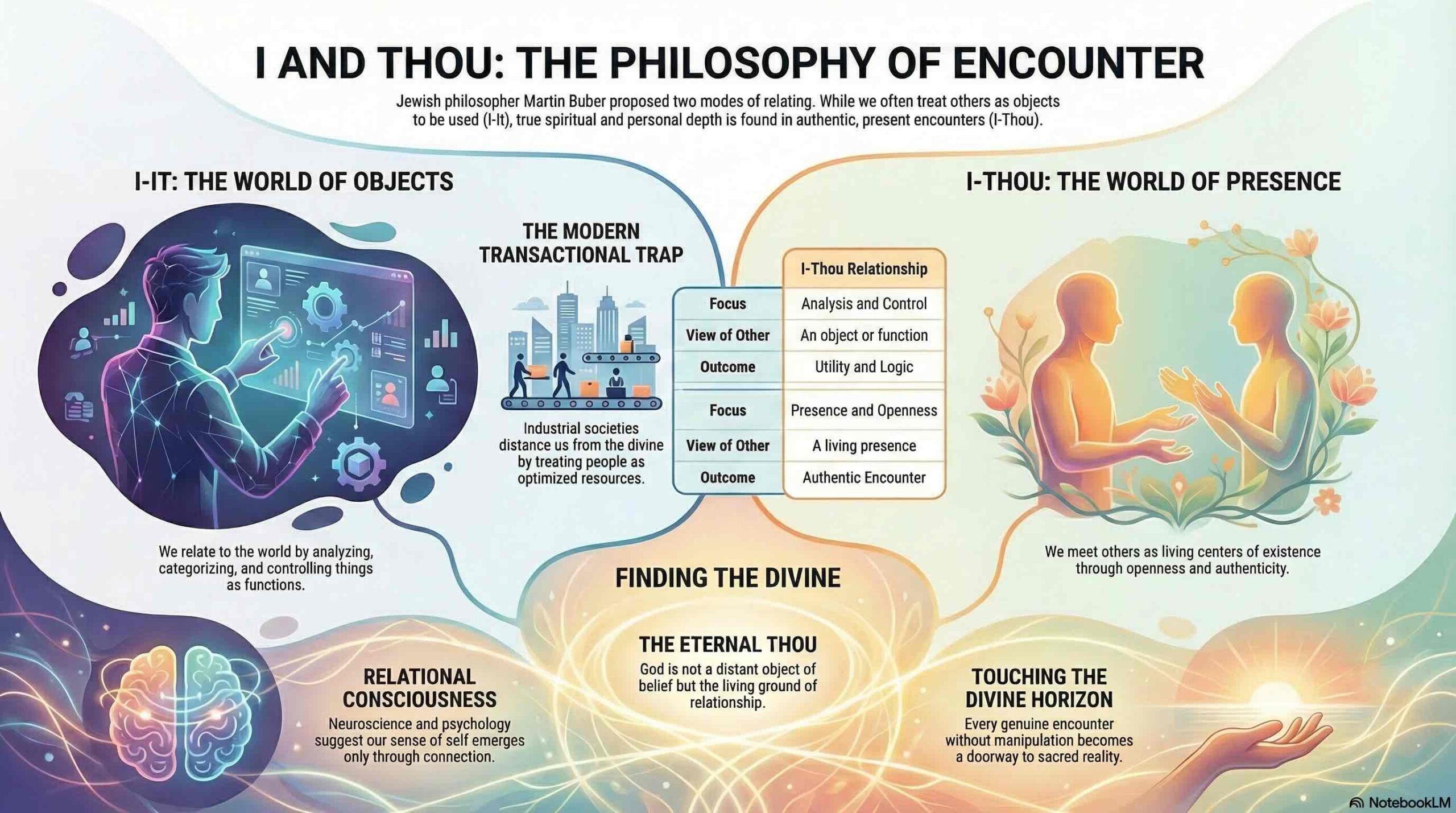
“The provided text explores the 20th-century philosophy of Martin Buber, who redefined the divine as an experience found through human connection rather than abstract doctrine. Buber distinguished between the “I-It” relationship, where we treat the world as a collection of objects to be used, and the “I-Thou” encounter, which involves a living presence between two beings. In this framework, God is not a distant entity to be analyzed but the “Eternal Thou” who becomes visible whenever people engage in authentic, transparent dialogue. Modern life often forces individuals into transactional roles, yet Buber argues that true faith is a participation in these deep, relational moments. Ultimately, the source suggests that the divine horizon is touched not through logic, but through the profound act of being fully present with another.”


“The longer I live,
the more I realize the impact of attitude on life.
Attitude, to me, is more important than facts.
It is more important than the past, than education, than money, than circumstances, than failures, than successes, than what other people think, say or do.
It is more important than appearance, giftedness or skill.
It will make or break a company… a church… a home.
The remarkable thing is we have a choice every day regarding the attitude we embrace for that day.
We cannot change our past…
we cannot change the fact that people will act in a certain way.
We cannot change the inevitable.
The only thing we can do is play the one string we have, and that is our attitude…
I am convinced that life is 10% what happens to me and 90% how I react to it.
And so it is with you… we are in charge of our Attitudes.”
Holger:
I like Charles’ 10/90% formula.
I had my own attempt to become scientific:
“The sense of separation
is 10% faulty thinking
and 90% muscle-memory.”
Yes, attitude is fundamental, but who is in charge?
Is there a personal, separate “me” that can change, or is beneficial change the byproduct of a deeper embrace of Being; seeing that we are not who we think we are.

I have nothing to protect,
I am not afraid to be hurt.
I am not this body-mind called Holger,
yet beyond doubt, I AM!
My happiness and fulfillment
is not dependent on circumstances.
Inner space – peace from the mind – come by grace; are priceless gifts, our birthright.
The me-belief, the hunger to be someone, was the veil hiding in plain sight what I was longing for.
Meeting and loving my Dutch Woman is not added from outside, but a maturity and ripeness beyond words.
It is wonderful to share,
for the benefit of all,
which includes myself.
Love,
Holger

PS: One day… MatingDepartment.com, just for fun.
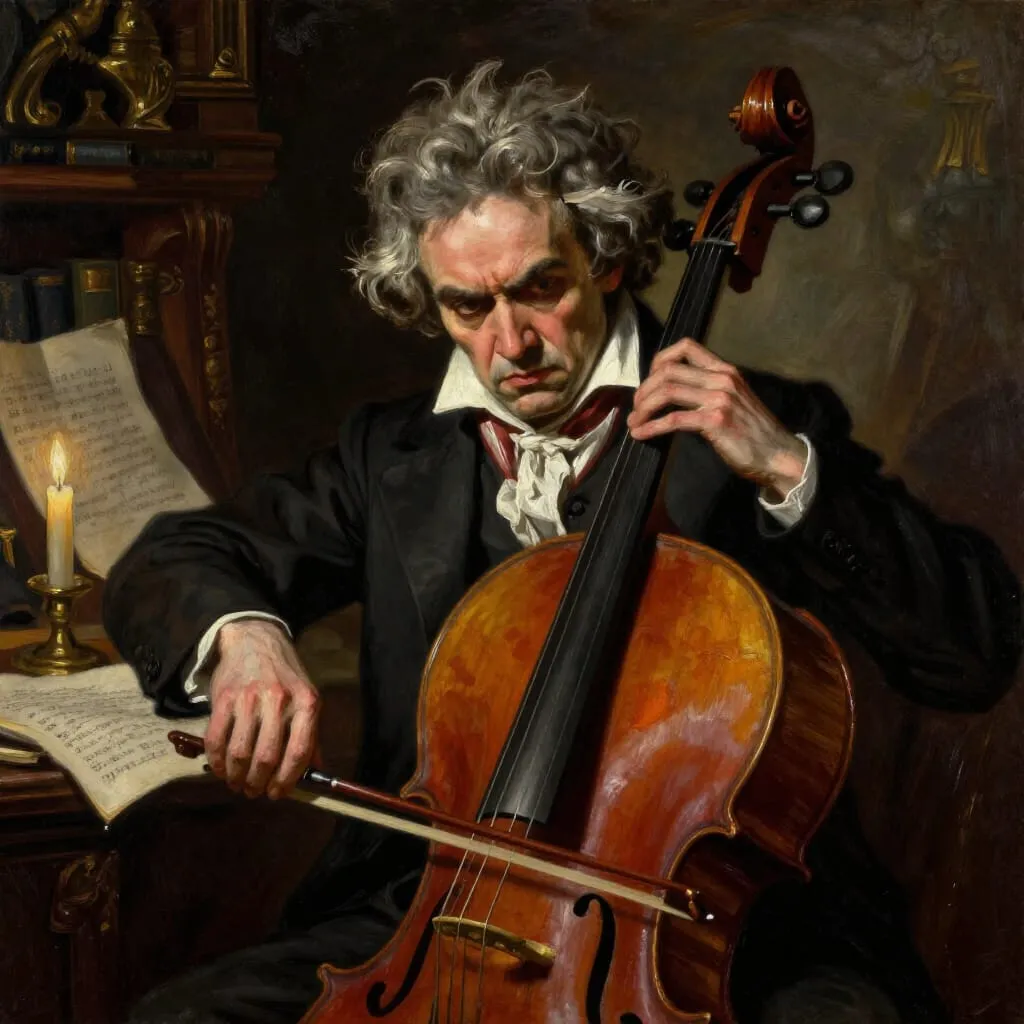
Beethoven Piano Sonata No. 29 in B-Flat Major, Op. 106 Hammerklavier 3. Adagio sostenuto
Brendel was born on 5 January 1931 and died on 17 June 2025.
Alfred Brendel was a Czech‑born Austrian pianist, writer, and lecturer, widely regarded as one of the great interpreters of the Austro‑German canon, especially Beethoven, Schubert, Mozart, and Liszt. His playing is often described as architectural, lucid, and intellectually rigorous, with a strong emphasis on fidelity to the score rather than overt personal display.
Thank you Rupert Spira for recommending Beethoven’s 29th!
🕊️ 💤 🪴
Thank you Rick for recommending #5!
Different dynamics than #29 🎉.
I am very happy that Elsbeth found such a. loving friend ❤️ in you!